Two marina-front listings can sit three streets apart in Hawai'i Kai, carry nearly identical asking prices, and expose their new owners to completely different bills five years from now. The difference has nothing to do with the dock, the view, or the square footage. It comes down to a single line buried in the property's governing documents: who is responsible for the wall holding the water back.
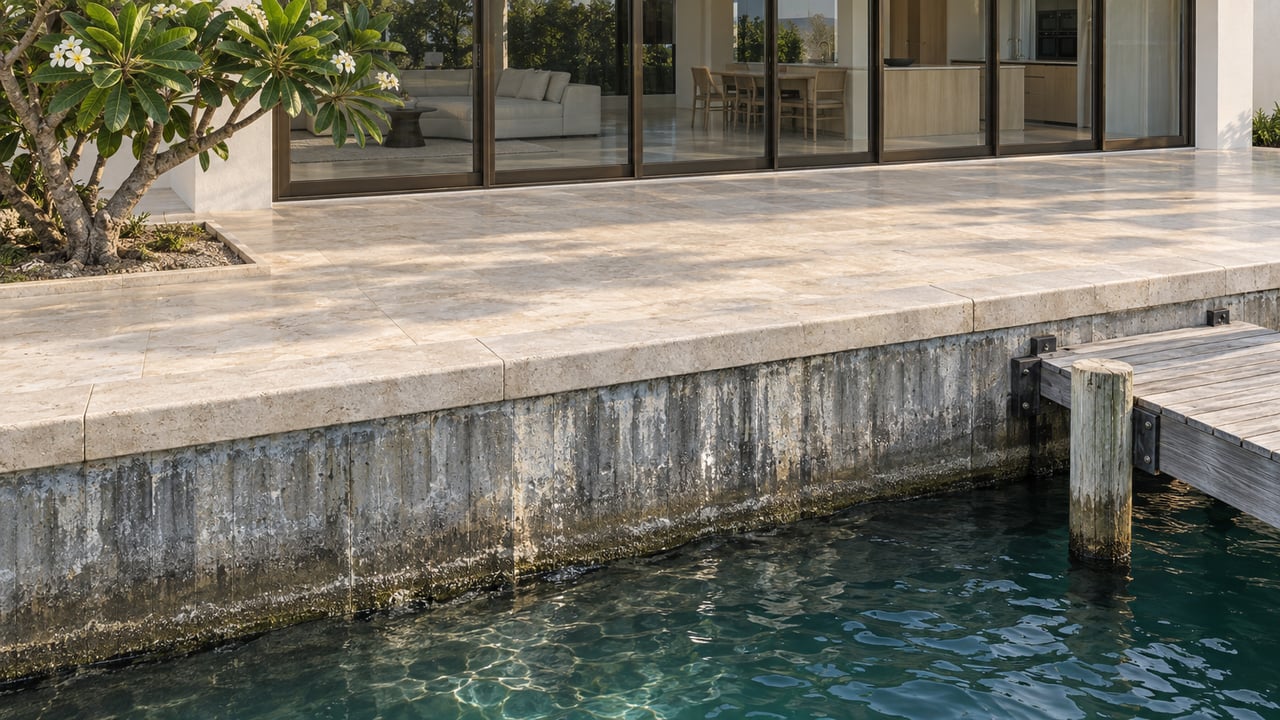
Hawai'i Kai remains the only neighborhood on Oahu where a buyer can purchase a home with a private boat dock attached to a residential lot. That scarcity is a real part of what drives price here, and it's exactly why so many buyers stop evaluating once they see the word "dock" in a listing. The dock is the amenity everyone photographs. The seawall behind it is the actual liability, and it isn't distributed the same way from property to property.
The Bridge That Decides What Your Dock Can Actually Hold
Not every dock in the marina delivers the same access to open water, and the constraint isn't distance to the ocean. It's bridge clearance.
Under the marina's own rules and regulations, the interior crossing beneath Kalanianaole Highway clears roughly 13 feet at mean lower low water, while the Keahole and Wailua bridges clear closer to 19 feet. A sailboat with a fixed mast that clears one bridge may not clear the other, which is why the marina's own guidance recommends a retractable mast for anyone who wants to sail both inside the marina and out in Maunalua Bay. Power boats face a similar ceiling, not from the bridges but from the marina's own speed rules: anything over 21 feet with a deep-V hull is required to run at slow, no-wake speed at all times inside the marina regardless of where its dock sits.
None of this shows up in a listing photo. A dock that looks identical to the one three doors down may sit on the wrong side of a low bridge for the boat a buyer actually owns, which means the real value of "private dock access" depends on where in the marina that dock is, not just on the fact that it exists.
The Seawall Is Where the Real Money Question Lives
The bridge clearance issue is a lifestyle constraint. The seawall issue is a financial one, and it's the one most buyers never ask about until they own the property.
The Hawai'i Kai Marina Community Association's own rules state plainly that seawalls are not a shared community expense. Maintenance, repair, and replacement of waterfront seawalls fall to whoever's land they front. For a single-family home, that means the individual homeowner carries the full cost alone. For condominium land, such as the seawall segments along Koko Isle Circle or fronting Kuapa Isle, the cost falls to that building's association. For the stretches near the shopping centers, it falls to those commercial property owners.
This isn't a hypothetical. The Hawai'i Kai Shopping Center itself completed a seawall repair project that ran from January through July of 2026, a recent, concrete example of what this category of repair actually looks like in scope and duration for whoever is on the hook for it.
Hawaii's courts have already had to sort out disputes over exactly this kind of responsibility. In a 2017 case involving Waikiki's Gold Coast, the state Supreme Court found that decades of public use of a privately built seawall had created a shared maintenance obligation between the state and the property owners, and sent the case back to a lower court to work out how the costs should actually be split. The ruling didn't touch Hawai'i Kai, but it shows that seawall liability in this state is a live legal question, not settled boilerplate, and that ownership of the wall and responsibility for it don't always land in the same place without a fight.
For a single-family marina lot in Hawai'i Kai, there's no ambiguity to litigate. The HKMCA rule is direct. The homeowner owns the repair.
| Property Type | Who Pays for Seawall Repair |
|---|---|
| Single-family marina lot | The individual homeowner, in full |
| Condominium or townhome (Koko Isle Circle, Kuapa Isle, and similar) | The condo association, funded through dues and reserves |
| Property fronting the marina shopping centers | The commercial property owner |
What This Means If You're Buying a Condo Instead of a Single-Family Lot
The condo route spreads the cost, but it doesn't eliminate the risk. Waterfront and marina-front buildings in Hawai'i Kai, places like the Esplanade, Mawaena Kai, or Kaimala Marina, typically carry higher association fees than a comparable inland building precisely because dock upkeep, seawall monitoring, and coastal maintenance sit permanently on the budget. That's the trade a condo buyer is actually making: a smaller individual exposure in exchange for a recurring fee that has to be large enough to keep pace with salt air, tidal wear, and the eventual cost of a bulkhead or dredging project.
The risk shows up when the fee isn't large enough. An association with an underfunded reserve can be years away from a special assessment that lands on every owner at once, and the only way to know the difference between a healthy reserve and a deferred one is to actually read the numbers: the current budget, the most recent reserve study, and whether that study specifically accounts for docks, seawalls, and dredging as separate line items rather than folding them into general maintenance.
For comparison, the marina's own community association, which governs the single-family side, sets annual dues at $600 for 2026, a figure that covers association operations but not an individual owner's seawall repair, which remains a separate and unbudgeted cost whenever it comes due.
The Comps Won't Tell You This Either
Hawai'i Kai's single-family home prices moved unevenly through 2026, and the inconsistency is itself worth understanding before leaning too hard on any one number. One board-based read put the neighborhood's median sale price for single-family homes near $1.57 million by mid-year, after a year-over-year dip. A separate market recap taken later in the summer put the median closer to $1.9 million. The gap isn't a sign that one source got it wrong. Hawai'i Kai sells a small enough number of homes each month that a handful of marina-front or view-lot sales can swing the median substantially in either direction.
That volatility is the same lesson as the seawall question, just applied to price instead of liability. A comp that looks like a fair comparison on paper, same neighborhood, similar square footage, similar sale month, can be hiding a completely different underlying property once you account for lot type, dock access, and who's actually responsible for what's protecting that lot from the water.
Before You Write an Offer
Anyone seriously considering a marina-front property in Hawai'i Kai should ask for a specific set of documents before removing contingencies, not after:
- The CC&Rs, condominium declaration, or recorded easement language that defines who owns and who maintains the dock and the seawall
- For condos, the current operating budget, the most recent reserve study, and any board minutes referencing planned marine infrastructure work
- Confirmation of whether the specific lot is classified as single-family, condominium, or commercial-adjacent for purposes of seawall responsibility
- The marina's dock modification approval process through the Marina Manager, since docks can't be added or altered without sign-off
- The guest boating pass limit, one visiting vessel per month per waterfront resident, if boat access is part of the appeal
- Whether the vessel a buyer actually owns or plans to own can clear the relevant bridge, given the roughly 13-foot clearance under Kalanianaole Highway versus the roughly 19 feet under Keahole and Wailua
None of these questions show up in a standard listing sheet. All of them change what the property actually delivers and what it might eventually cost.
If you're comparing marina-front listings in Hawai'i Kai and want a clear read on what a specific dock, seawall, and association reserve actually mean for your offer, Jaymes Song can pull the governing documents and walk through them with you before you're under contract. Expect better. Schedule your free market consultation.